Evolving Infra: serving agents means letting the cluster change its mind
Evolving Infra decouples prefill/decode roles from KV storage and evicts cache by active-branch counts instead of recency. Against NVIDIA Dynamo on agentic workloads it reports up to 4.1x lower mean latency and 14x lower P95 TTFT.
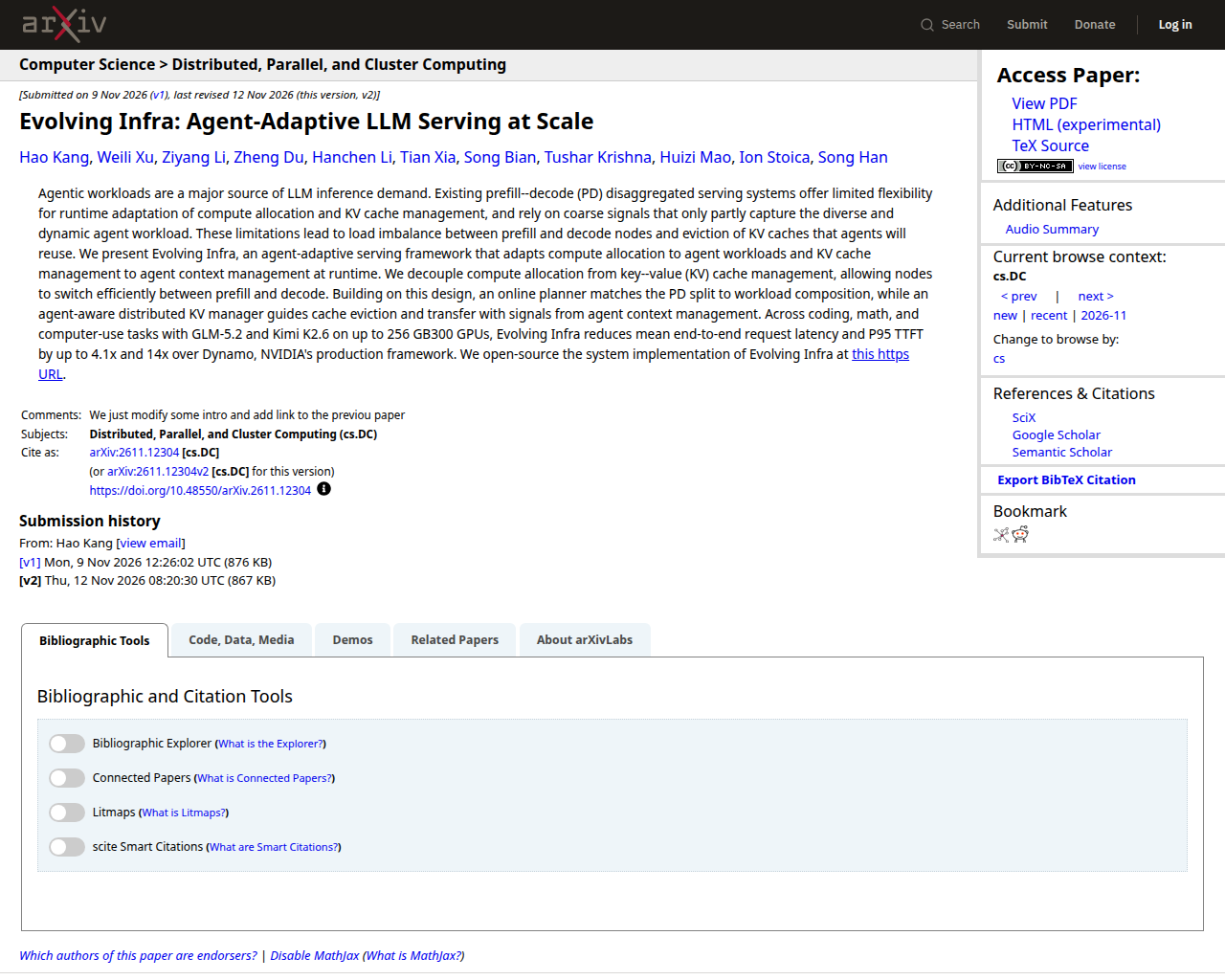
Most LLM serving stacks were designed for chat. A request arrives, prefills, decodes, and leaves. Agents don't work that way. They fork, spawn sub-agents, compact their history, and go quiet between turns (the median gap between consecutive GitHub Copilot turns is 172 seconds), then come back expecting their prefix to still be warm. The paper Evolving Infra: Agent-Adaptive LLM Serving at Scale (Kang, Xu, Li et al., MIT, Berkeley, NVIDIA, OpenAI and others) argues that prefill-decode disaggregation, the current production pattern, makes two assumptions that agent traffic breaks. I think the diagnosis is right, and the fix is worth understanding even if you never deploy their code.
Two assumptions that agents break
The first assumption is that the prefill-to-decode ratio can be fixed at deploy time.A computer-use agent on OSWorld is prefill-heavy because every step appends a screenshot. A math agent on PutnamBench is decode-heavy because each request emits a long reasoning trace. Their best static splits on nine nodes range from 2P7D to 6P3D. When the traffic mix shifts from Putnam to OSWorld, the best split per 10-minute window moves from 3P6D to 7P2D, and the best single static split loses up to 24% of throughput in the periods it doesn't fit.
The second assumption is that recency predicts KV reuse. On Claude Code traces, 98% of the prompt after a 359-second sub-agent call matches earlier KV, but only 14% after a 12-second compaction. LRU gets this exactly backwards: it evicts the branch that is patiently waiting for a tool and keeps the history that compaction just made dead.
Existing systems can't fix either problem cheaply because compute role and KV storage are coupled. Dynamo changes a node's phase by relaunching its worker, which the authors measured at 681 seconds per switch on Claude Code traces, with the node out of service the whole time. Arrow switches in place but strands the node's cache, losing 55.5% of available KV reuse over 34 switches. So planners either switch rarely and stay wrong, or switch often and pay for it.
The design: decouple, then count

Evolving Infra has three pieces.
Symmetric engines. Every node runs one SGLang-derived scheduling loop that can serve either phase, with bidirectional KV transfer over Mooncake's RDMA transport. Switching a node is just the router changing which requests it sends there. After draining, the switch takes 0.7 seconds. Averaged over nine settings, including the wait for running requests, it takes 6.2 seconds, against 754 seconds for a Dynamo relaunch.
A shared host-memory KV pool. Every node's host memory is pooled and readable over RDMA by any node, so a phase switch strands nothing. One detail matters.HiCache-style pools load fetched KV into GPU memory only when prefill starts, which adds the fetch to TTFT. In the authors' routing study, adding a shared pool to the Dynamo router raised P95 TTFT from 65 to 95 seconds for this reason. Evolving Infra finishes the whole fetch, into GPU memory and broadcast across the node's GPUs, while the request is still queued.
An agent-aware KV directory. This is the part I like most. The router keeps a cluster-wide prefix tree, but each block on each node also carries a count of active branches that reference it. The harness tags each request with a branch ID and reports when branches fork, spawn, or finish. The router bumps a branch version on compaction. Eviction then sorts by (count > 0, last access): zero-count blocks go first, in LRU order, and live branches are evicted only when nothing else is left.

A planner that models work, not load
Once switching is cheap, the question is when to switch. Existing planners watch queue depth, KV utilization, or predicted TTFT computed from full input length. All three are fooled by agents. A harness that spawns five sub-agents at once creates a burst that looks like a demand shift, and counting cached prefix tokens overestimates prefill demand. In the motivation study, Arrow drifted to 8P1D and Dynamo drifted to 2P7D, delivering 65% and 49% less throughput than the best static split.
Evolving Infra replaces those signals with roofline-style iteration-time models fitted online by nonnegative least squares during a collocated warmup. Prefill time depends on uncached tokens, query-key pairs, and tokens restored from host memory; decode time on the expected fraction of MoE experts touched and a per-request term.The models stay within 7% mean error outside the fitted settings and converge in about a minute. The planner evaluates candidate splits on the average request work over a 600-second window cut into 10 slices, and it switches only if the mean throughput gain beats twice its standard error. As a physicist I appreciate that this is a hypothesis test rather than a threshold someone tuned once. It is also why the system switched only about twice per run.
Routing uses the same models. Each prefill request goes to the node with the smallest predicted TTFT: remaining batch time, plus the queued work, plus its own work.
Results, and what to read carefully
On 36 GB300 GPUs serving GLM-5.2 and Kimi K2.6, against Dynamo v1.5.1, Evolving Infra reports 1.10-2.73x throughput, 81-95% less lost KV reuse, 1.15-4.12x lower mean end-to-end latency, and up to 13.92x lower P95 TTFT. On a three-hour run that shifts from Putnam to OSWorld, it gets 2.14x Dynamo's throughput and 1.28x the best static split. Enabling online adaptation when already at the best split costs 0.3% throughput. Offline profiling of the three-hour Claude Code trace on 256 GPUs would instead take 10,752 GPU-hours.
A few things are worth keeping in view. The big multipliers come from Claude Code and OSWorld. On decode-heavy Putnam the latency gain is 1.15-1.23x, and the planner deliberately trades P95 TTFT for throughput, ending up worse than Dynamo on that metric at two of three concurrency levels. Arrow's code isn't public, so it was reimplemented on the authors' engines. The Claude Code replay fixes output lengths and tool durations to their recorded values, which is right for reproducibility but removes some real-world variance. Interestingly, ThunderAgent-style agent pausing gave 0.95x here, because KV capacity isn't the binding constraint on GB300 nodes. That conclusion may not hold on smaller-memory hardware.
What I'd take from it
The practical requirement is on the harness side: your agent framework has to emit branch IDs and lifecycle events (fork, spawn, compact, finish) to the serving layer. That is a contract most teams don't have today, and I'd argue it's worth considering even before you change engines. The effort depends on your harness, but in this paper it is the most direct signal of which context is still alive. Recency and queue depth are proxies, and agent traffic is exactly the workload where they fail. The code is open source. If you run agent inference at scale, the eviction policy alone is worth a weekend of reading.