PDD Kit and the case for reviewing intent instead of agent code
Microsoft Research's PDD Kit turns developer intent into a Verus specification, proves agent-written Rust against it for every input, and labels what only tests can cover. The useful shift is where human review goes: from the diff to the spec and the list of trusted assumptions.
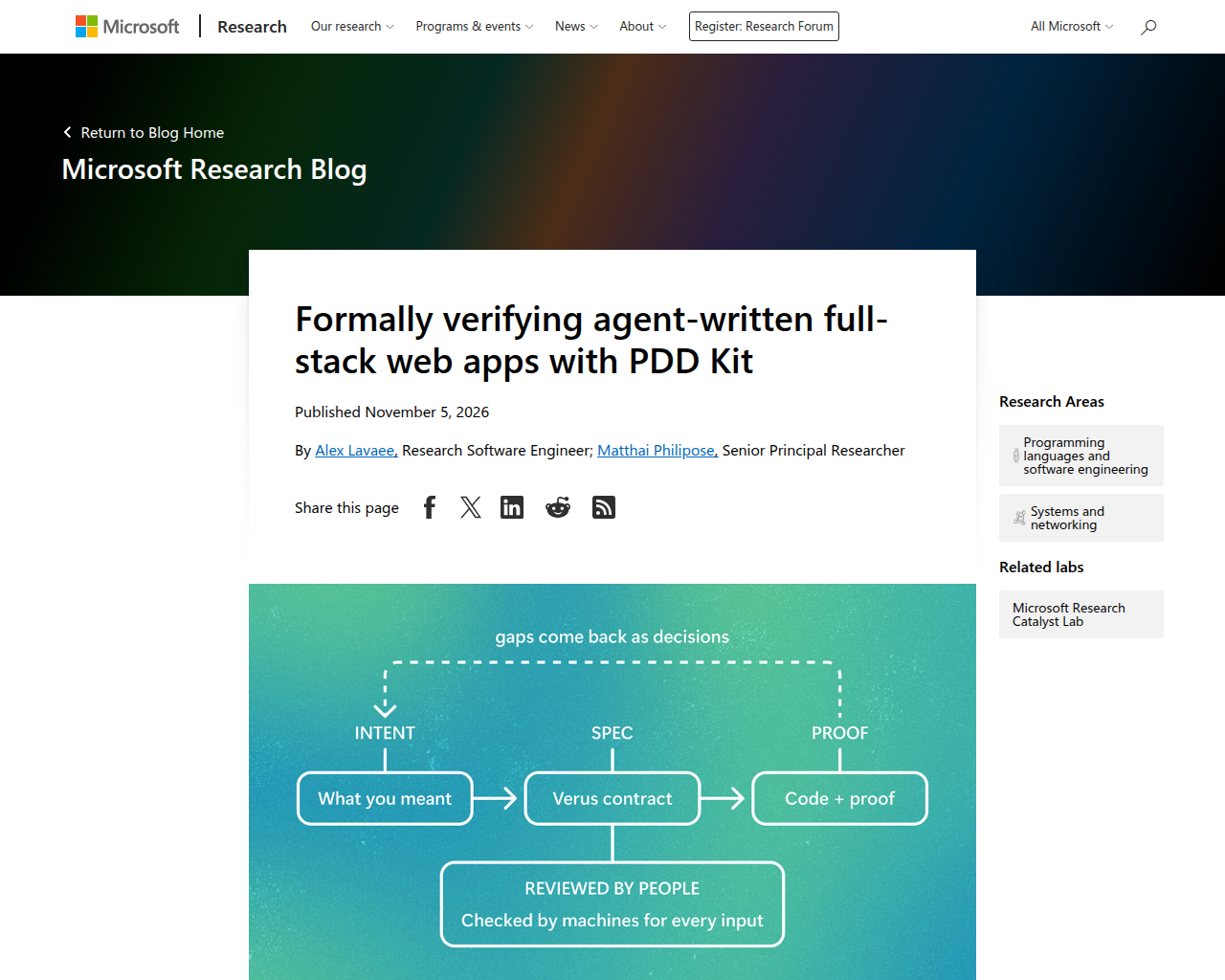
Microsoft Research has published PDD Kit, a toolkit for what its authors call Proof-Driven Development. It works with a developer to turn intent into a formal specification in Verus, proves that agent-written code meets the specification for every input, and falls back to tests where a proof can't reach. The demonstration is the login logic of a full-stack Rust web app.
I think this is worth attention because of the problem it names, more than the tool itself. Agents can now produce more code than anyone can read, and the tests they write tend to confirm what they built, not what you asked for.
What shipped
PDD Kit runs as a partner inside Chopin, GitHub Next's multiplayer planning environment, and its workflow has two halves.
First, the team settles intent in plain language. PDD Kit reads the code, asks the questions a careful reviewer would ask, and records the answers in an intent artifact. Then that artifact splits. Whatever can be formalized becomes a Verus specification, with generated proofs. Whatever can't, such as a third-party cryptography library or a user interface, becomes an informal specification covered by unit tests, end-to-end tests, browser agents, and computer-use agents.

The design choice I like most is the labeling. Every result states which kind of verification it rests on. A proof is a proof, and a passing test is reported as evidence. The line between them is the Trusted Computing Base, the code the proof assumes behaves as described, and PDD Kit asks you to sign off on each piece of it.
The login example
The test case is Pet Store, a storefront of about 5,000 lines of Rust, with an Axum and SQLite backend and a Leptos frontend compiled to WebAssembly. The developer's requirements were deliberately rough: "You only get a token with the right password. Only admin accounts get admin tokens."
PDD Kit's first move was a question. "Only with the right password" is satisfied perfectly by a login that refuses everyone. The sentence gives you token ⇒ right password. To rule out the useless implementation you also need the converse, which the authors shorten to "the right password always works." Together they make an "if and only if."
That shorthand is stronger than the guarantee itself. The contract in the worked example still permits lookup and signing failures that return HTTP 500, and it does not guarantee termination. So the proved claim is narrower: when the handler finishes and neither of those steps fails, the right password gets a token.
An agent working alone would pick one reading and not tell you, and both readings pass a plausible test suite. The two differ only in the case of a right password that gets no token.
The reported result is that Verus hardened the code and uncovered existing bugs, and that the developer reviewed the intent without reading the generated code line by line.
Why it matters
Proofs used to be too expensive for ordinary software. The authors argue that changed because agents can now help write both the specs and the proofs. If that holds, the reviewer's job changes too. You stop asking "does this diff look right?" and start asking "is this the property I meant?"
My training is in physics, and the distinction reads familiarly to me. A measurement tells you what happened in the cases you ran. A theorem tells you what must happen everywhere its assumptions hold. Coverage numbers blur that line, and a tool that keeps it visible is doing real work.
Where I would stay careful
A proof moves risk; it does not remove it. The claim is correctness with respect to the specification, and the authors phrase it that way. A wrong spec gets proved just as firmly as a right one, so spec review becomes the critical step. The trusted computing base deserves the same scrutiny, since every sign-off there is an assumption the proof will not check.
Scope matters too. The worked example is one sensitive module in a 5,000-line app, while the motivating problem is agents shipping tens or hundreds of thousands of lines. The authors say the same process extends to the whole app and recommend starting with the most sensitive parts. Verus also means Rust, so stacks in other languages are out of reach for now.
Still, the sequence is one I would adopt now, even without proofs: settle ambiguities before code exists, tie each requirement to what checks it, and state plainly what is proved, what is tested, and what is trusted.