TypeSafe AI's Jev bets that most production AI isn't chat, it's a decision
TypeSafe AI has launched a new class of model it calls System One: schema-constrained, calibrated, and sampled in parallel instead of token by token. Here's what that trade actually buys you, and where the claims still need independent verification.

TypeSafe AI announced its first System One Model on September 15, 2026: a model called Jev that gives up open-ended text generation entirely in exchange for typed, calibrated decisions that plug directly into software. The founder, Diogo Almeida, helped build the instruction-tuning work behind ChatGPT at OpenAI, so the pitch carries some weight: models have been superhuman at chat for years, he argues, and that still hasn't translated into the level of automation you'd expect. His diagnosis is that chat-shaped models are the wrong tool for a huge share of what production AI systems actually do.
I think the diagnosis is right, and the architecture is worth understanding in detail, even before you can verify the numbers.
What actually changed
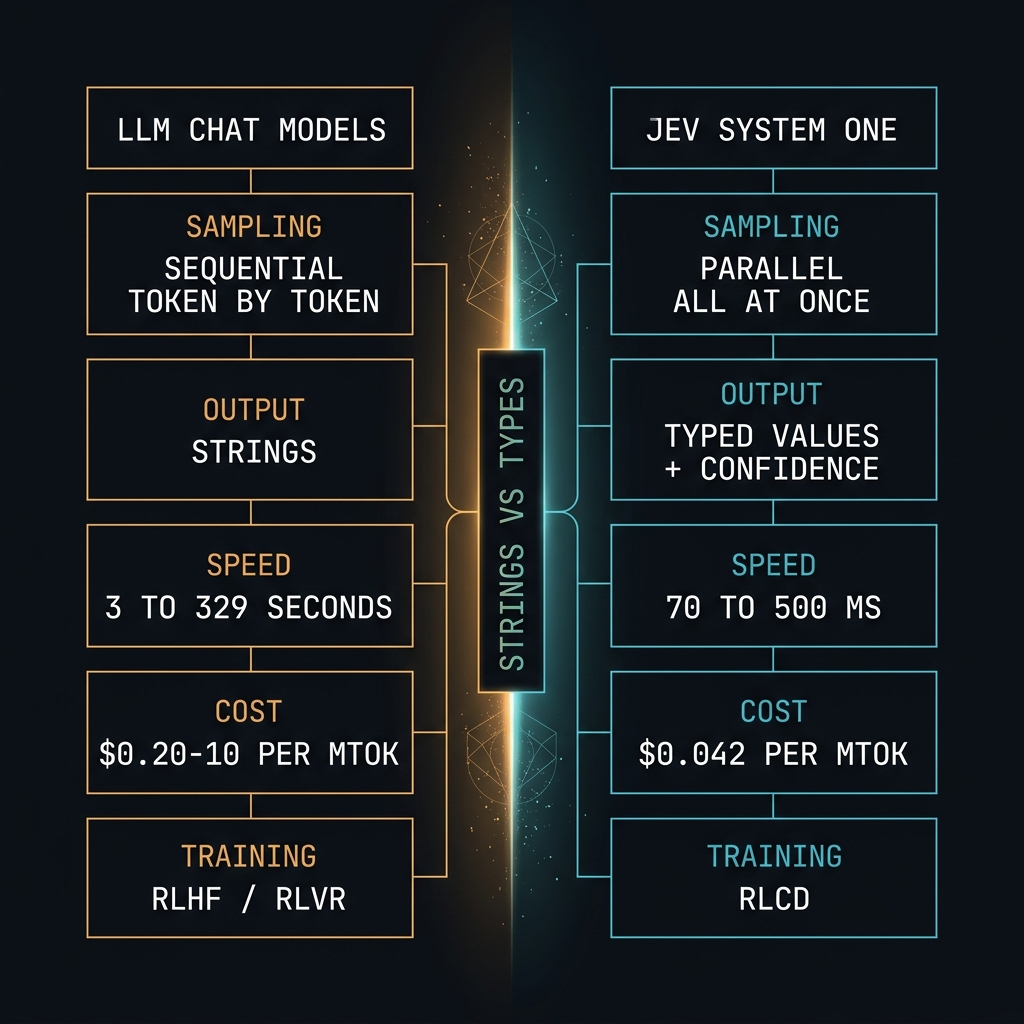
Every LLM you've used generates a string, one token at a time, each token conditioned on the last. That's what makes chat fluent and open-ended, and it's also why using an LLM as a classifier, router, or extractor inside a pipeline means wrapping it in JSON mode, a parser, a retry loop, and a validator that catches the cases where it emits something your schema doesn't accept. Jev removes that entire layer by construction: the space of possible outputs is defined in advance, sampled in parallel in a single pass, and schema conformance is guaranteed rather than checked after the fact. TypeSafe calls this a System One Model — fast, structured judgment, as opposed to the slower, generative work chat models do.
The training method is different too. Standard LLMs are optimized with RLHF or RLVR: human preference on writeups and chat responses, or programmatically verifiable rewards on tasks like math and code. Jev is trained with what TypeSafe calls Reinforcement Learning for Calibrated Decisions (RLCD), which optimizes directly for calibration — if the model says 80% confidence, it should be right about 80% of the time. Every output ships with a probability attached. That's the detail I'd watch most closely, because calibration, not raw accuracy, is what determines whether you can actually automate a decision. A model that's right 95% of the time but can't tell you when it's in the unreliable 5% isn't safe to wire into a system without a human checking its work.
The numbers, with the caveats attached
TypeSafe publishes pricing at $0.042 per million input tokens with output free, against a frontier LLM range of roughly $0.20–$10 per million input tokens with output priced around 5x higher. Latency is quoted at 70–500ms end to end versus 3–329 seconds for frontier chat models on comparable tasks — a 40x to 200x gap on what they call System One-shaped queries. On their own workflow evaluations, benchmarked against the average of GPT-6 Astra and Fable 5.1 as a reference, they report up to 193.6x faster and 444.6x cheaper.
TypeSafe is upfront that these numbers deserve scrutiny, which is more disclosure than most launch posts bother with. The published evals run from their own infrastructure on the West Coast. The workflow benchmark's reference answers come from averaging two labs' models, which structurally biases the comparison toward OpenAI and Anthropic and likely understates how DeepSeek's models would do. The "zero type errors" claim is the one genuinely load-bearing guarantee — it follows mathematically from constrained sampling over a fixed schema, so it isn't an empirical claim at all, unlike everything else in the post. Cost sustainability is explicitly unproven; they say pricing isn't provably unsubsidized and will need time to validate. That's a reasonable amount of humility for a launch, but it also means the headline multipliers are self-reported until someone outside TypeSafe reproduces them.
Where this fits, and where it doesn't
Jev isn't a chatbot competitor and TypeSafe doesn't pitch it as one. The use cases in the announcement are the ones that make sense once you separate the two jobs: classification, routing, scoring, and extraction — the "smart if-statement" work that today gets bolted onto LLM calls with brittle parsing — plus real-time scoring where 100ms matters, map-reduce over large datasets, and using a calibrated model as a guardrail to verify or judge another model's output. Their demos, a real-time text-based Doom bot and a Wikiracing agent choosing among hundreds of Wikipedia links per step, are chosen to show the two things that matter for automation over generation: speed per decision and reliability at high-cardinality choice (Jev reportedly supports up to 255 options per decision, scored in two stages for the largest sets).
What it gives up is exactly what makes chat models general: open-ended text, code, conversation, anything where the right answer isn't a value from a predefined schema. That's a real trade, not a limitation to route around, and the interesting architectural question this launch raises is whether production AI systems end up as two-model stacks by default — a generative model for judgment and language, and a typed, calibrated model doing the high-frequency decision-making underneath it. That division of labor matches how I'd want to build a serious agentic system regardless of whose model does the deciding.
Jev is in early access now, with the full technical writeup, side-by-side demo, and workflow eval details on TypeSafe's site. I'd treat the specific multipliers as directional until third parties can reproduce them, but the underlying premise — that most of the value in production AI is decisions, not prose — is one I've been operating on for a while.