StrataFlux: low-bit inference that borrows precision from the memory hierarchy
StrataFlux keeps 2-4-bit weights and KV cache on the GPU and streams extra precision from host RAM or SSD only where each token needs it, recovering much of the accuracy lost to aggressive quantization at near-quantized speed. Here is how it hides the transfer latency, what the numbers show, and where I would be careful.
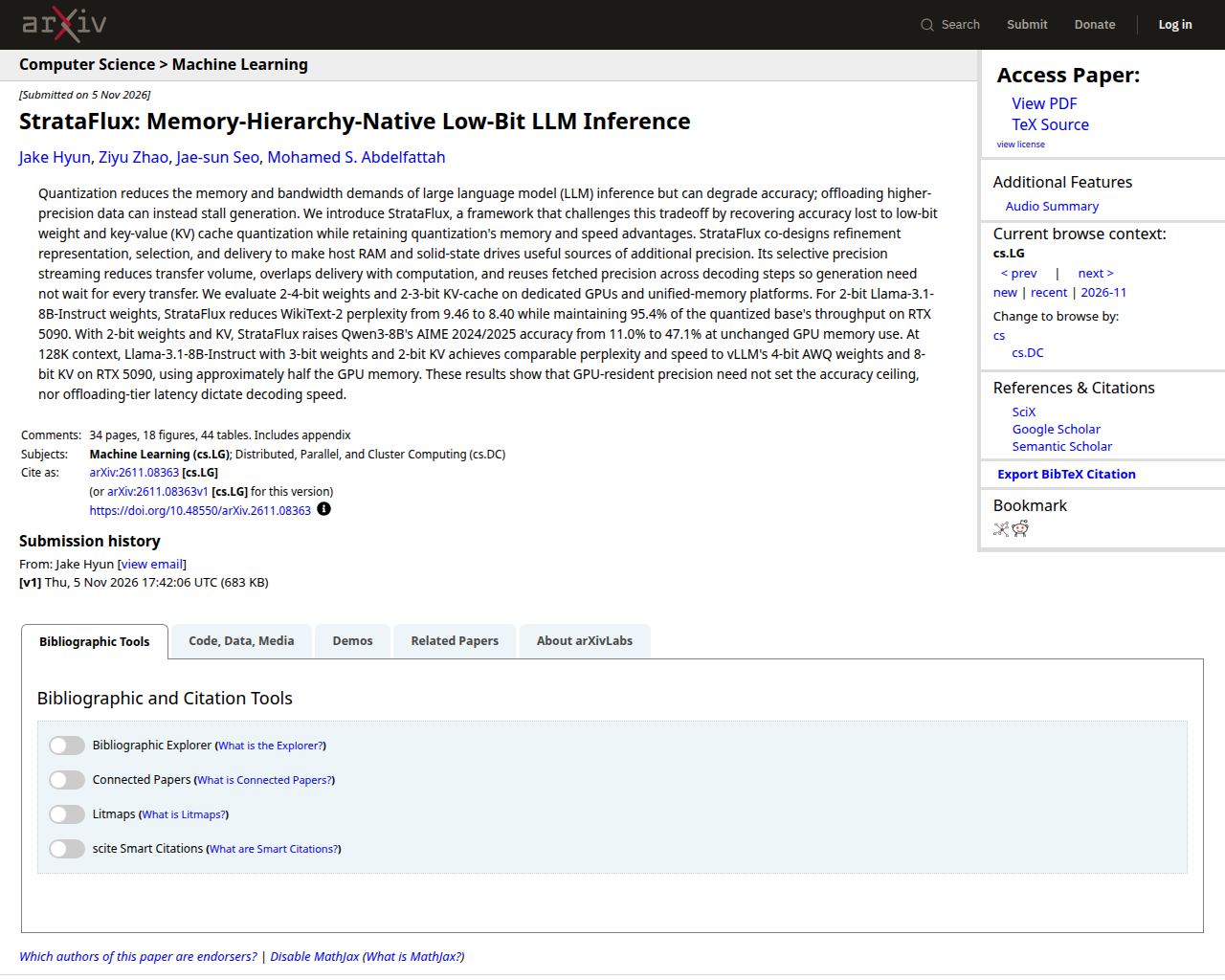
Quantization and offloading are usually presented as two separate answers to the same problem: the model does not fit in fast memory. Quantize, and you keep speed but lose accuracy. Offload, and you keep accuracy but decoding waits on PCIe or an SSD. A new paper from Cornell and Carnegie Mellon, StrataFlux: Memory-Hierarchy-Native Low-Bit LLM Inference (Hyun, Zhao, Seo and Abdelfattah), argues that this is a false choice. Their claim is that the bits you throw away when you quantize do not have to be thrown away. They can sit in host RAM or on an SSD and be streamed back in, selectively and asynchronously, only where the current token needs them.
I think this is one of the more practically interesting inference papers of the autumn, because it treats the memory hierarchy as part of the numerical representation rather than as a place you spill to when you run out of room.
The core idea: resident base, streamed refinement
StrataFlux keeps a compact 2-4-bit copy of the weights and a 2-3-bit KV cache resident on the GPU. That is the base. The extra precision, which the authors call refinement bits, lives in a cheaper, slower tier: pinned host RAM on a discrete GPU, or SSD with a RAM cache on unified-memory machines such as DGX Spark and Apple silicon.

Fetching all of that precision would erase quantization's bandwidth savings. The approach works because importance is very uneven, and the uneven part can be identified cheaply at runtime:
- Weights. The projection error from quantization is a sum of residual columns weighted by input activations, so channels with large |x_i| dominate it. Following DecDEC, StrataFlux picks the top-k channels per 1,024-channel chunk and fetches 4-bit residual columns for just those. It also fits the refinement values on calibration data, so the selected columns partly compensate for the channels that were left out.
- KV cache. Rather than fetching full FP16 replacements for important tokens (as SpeCache does), it uses nested quantization: the fetched bits pick a finer value inside the interval the resident 2-bit code already represents. Tokens are scored by attention weight computed from the resident low-bit keys. In the main configuration only 1/128 of token groups are refined, with 4 extra bits per key and value element.
The paper's Figure 3 makes the case for selectivity well: refining a small top-ranked fraction of channels or tokens removes a disproportionate share of output error compared with random selection.
Hiding latency is the real contribution
Selecting fewer bits only shrinks the transfer. It does not hide it. The numbers here are not friendly: on DGX Spark, the authors measure a median 2 KB random SSD read of 200 µs (709 µs at p99), against an average of 21 µs for a 2-bit output projection on Llama-3.1-8B. Any scheme that fetches during the projection it refines will stall.
StrataFlux widens the window in two ways, both exploiting the residual stream:
- Fetch lead. Query/key/value and gate/up projections read from the residual stream, whose direction changes slowly across blocks. So the runtime can predict which channels matter using an activation from s blocks earlier and start the fetch before the projection runs.
- Fetch lag. Attention-output and down projections write to the residual stream, so their refinement can be added a block or so later without much loss.

On top of that, selections recur across decoding steps, so a small least-recently-used RAM cache gets high hit rates. On a miss, the default on unified-memory platforms is to skip: use the low-bit value this step and let a background CPU thread load the bits for later steps. Generation never waits for the SSD. A tuner then picks per-projection channel budgets and shift distances under a user-specified slowdown limit, typically 5%.
What the numbers say
Everything is implemented end to end in llama.cpp, with CUDA and Metal backends. The headline results are concrete:
- 2-bit weights, Llama-3.1-8B-Instruct, RTX 5090. WikiText-2 perplexity drops from 9.46 to 8.40 at 95.4% of the quantized model's throughput. DecDEC, the closest prior system, reaches 9.03 at the same 5% slowdown budget. BF16 is 7.22.
- Against naive offloading at 3.9 GB of VRAM. StrataFlux-W decodes at 234.4 tok/s, against 5.1 tok/s for llama.cpp partial offloading of BF16 weights. Offloading gets you the better perplexity, at roughly 1/45th the speed.
- Reasoning. With 2-bit weights and 2/2 KV, Qwen3-8B on AIME 2024/2025 goes from 11.0% to 47.1% at unchanged GPU memory. BF16 scores 71.0%, so this recovers a large share of the gap, not all of it.
- Long context. At 128K, Llama-3.1-8B with 3-bit weights and 2-bit KV matches vLLM's AWQ 4-bit weights plus 8-bit KV on perplexity and speed, using about half the GPU memory. KV-only refinement lifts RULER accuracy at 128K from 68.6% to 78.1% (BF16: 77.9%).
Where I would be careful
A few things temper the headline for anyone thinking about production:
- This is a single-stream result. KV refinement costs 11.2% of throughput at batch 1 and 18.8% at batch 16 on an RTX PRO 6000, and 25.4% at batch 16 on DGX Spark. Weight refinement relies on the memory-bound projection leaving GPU cores idle, which holds less well as batches grow. This is a local and edge story first, not a serving-cluster story.
- The storage is not free, it moves. For 2-bit weights and 2/2 KV at 128K, the paper reports roughly 8.7 GB in the backing tier on top of the GPU-resident copy. That is still far below the 33 GB BF16 reference, but you need the host RAM or SSD to hold it.
- Tuning is per deployment. The authors tune each model, quantizer and platform separately, and found that neither the channel-wise nor the neuron-wise MLP scheme wins everywhere. Expect calibration work, not a drop-in flag.
- Skipped misses make quality state-dependent. Output quality depends on what happens to be cached, which complicates reproducibility and evaluation.
Why it matters
The idea I take away is not any single kernel. It is the reframing: GPU-resident precision does not have to be the accuracy ceiling, and backing-tier latency does not have to set decoding speed, as long as representation, selection and delivery are designed together. For anyone running 8B to 30B models on a 16-32 GB card or a unified-memory box, that changes the arithmetic. You can quantize harder and buy back accuracy with RAM you already have.
The name is marked as provisional and I did not see a code release mentioned, so I would treat this as a strong research result rather than something to deploy this week. It is worth reading the full paper, particularly the fetch lead/lag analysis in Section 2.3. I expect that part to outlast the rest.